How Many Flowers Are in a Bouquet? Stem Counts by Size
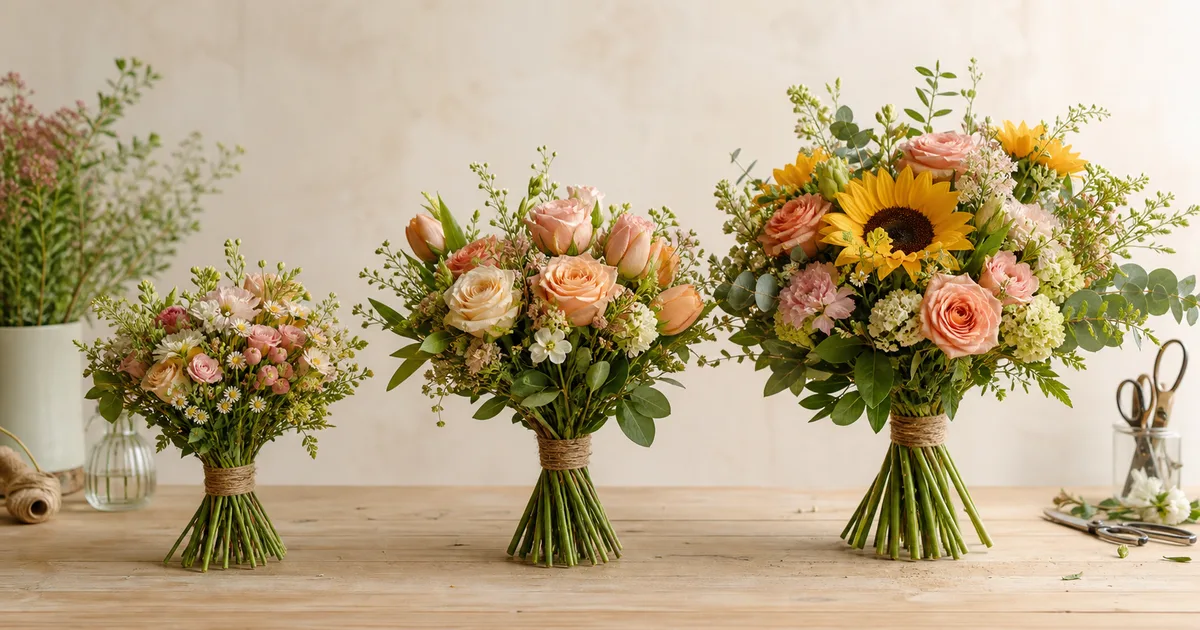
There is no single industry-wide number of flowers in a bouquet. Ten stems can look generous when they include open sunflowers or hydrangeas, while twenty slender tulips or spray flowers may still read as a compact design. Stem count is useful only when it is paired with flower-head size, bouquet shape, foliage and the container.
This guide gives practical planning ranges for gift bouquets and home arranging. They are reference points—not promises about a florist's “small,” “medium” or “large” product, and not fixed recipes for every flower.
Quick answer
Start with about 8–15 total stems for a small bouquet, 15–25 for a medium bouquet and 25–40 or more for a large bouquet. Count focal flowers, secondary flowers, fillers and greenery if you mean the whole design. Then adjust downward for large flower heads and upward for smaller blooms, narrow stems or an airy style.
Small, Medium and Large Bouquet Stem Counts
| Planning size | Total stems | Typical use | Main adjustment |
|---|---|---|---|
| Small | About 8–15 | Simple gift, petite hand-tied bouquet, small vase | Use fewer stems when focal flowers are wide or fully open |
| Medium | About 15–25 | Everyday gift bouquet, birthday or table display | Add stems for a rounded dense shape; use fewer for an airy design |
| Large | About 25–40+ | Milestone gift, larger room or statement display | Check weight, handle comfort, vase opening and transport |
Retailers and florists define size labels differently. A premium bouquet with twelve large focal flowers may cost more and look fuller than a thirty-stem bouquet dominated by inexpensive fillers. Compare the actual flower list, dimensions and vase—not the size label alone.
What Counts as One Stem?
A stem count usually counts physical cut stems, not individual blossoms. One standard rose stem may carry one main bloom, while a spray rose, chrysanthemum or branching filler can carry several flower heads. Greenery also contributes volume even when it is not included in a seller's advertised “flower count.”
- Focal stem: a visually dominant flower such as a rose, sunflower, peony or hydrangea.
- Secondary stem: supports the palette and shape without being the main focal point.
- Filler stem: often branched, creating many small flowers or textural points from one stem.
- Foliage stem: adds outline, spacing and support; it may or may not be included in a merchant's stated count.
When shopping, ask: “Does the stated count include greenery and filler stems, or only flower stems?” That question is more useful than assuming every listed stem equals one visible bloom.
How Flower-Head Size Changes the Count
Iowa State University Extension notes that flower size, foliage size, stem length and the container all affect proportion. Use that principle before choosing a number:
- Large heads: hydrangeas, large sunflowers and open peonies create visual mass quickly, so fewer stems may fill the same space.
- Medium heads: standard roses, carnations and many tulips form a flexible middle range.
- Small or branched flowers: spray roses, asters, waxflower and similar materials may need more stems for dense coverage, although each stem can carry several blooms.
- Opening stage: tight buds occupy less space on arrival than fully open flowers and may change shape in the vase.
Single-Flower vs. Mixed Bouquet Counts
A single-flower bouquet is easier to count because most stems have a similar visual role. A mixed bouquet needs a recipe. The example below is one way to divide a total count; it is not a required florist formula.
| Size | Focal stems | Secondary stems | Filler/foliage | Example total |
|---|---|---|---|---|
| Small | 3–5 | 3–6 | 2–4 | 8–15 |
| Medium | 5–8 | 6–10 | 4–7 | 15–25 |
| Large | 8–12 | 10–16 | 7–15 | 25–43 |
If the focal flower is very large, reduce its count before cutting the support ingredients. If the bouquet is intentionally loose, spacing and line flowers may create width without filling every gap.
Rose, Tulip and Sunflower Examples
Rose bouquet stem counts
Six to twelve standard roses can form a compact bouquet, while eighteen to twenty-four can create a fuller single-flower presentation. Spray roses behave differently because one stem may hold several smaller blooms. Greenery, opening stage and wrapping can make the same rose count look very different. Use our rose color guide after choosing the approximate scale.
Tulip bouquet stem counts
Tulips are often handled in multiples of ten at wholesale and retail, which makes ten, twenty or thirty stems convenient planning points. Ten can suit a narrow vase; twenty makes a fuller hand-tied bunch; thirty creates more volume but also more movement and weight. Tulips continue to move and change in the vase, so leave breathing room and review our tulip vase-care guide.
Sunflower bouquet stem counts
Large sunflower heads can dominate with only three to five focal stems in a small mixed bouquet. Five to eight may anchor a medium bouquet, while a larger design might use eight to twelve—provided the stems, handle and vase can support the weight. Smaller sunflower varieties may need a higher count. Treat these as composition examples, not package standards.
Match the Bouquet to the Vase
A wide vase opening can make a modest count fall outward and look sparse; a narrow neck supports fewer stems. Before buying or cutting flowers, measure the opening and consider the room available for the flower heads.
- Bud vase: usually one to three deliberate stems rather than a miniature crowded bouquet.
- Narrow everyday vase: often works with a small planning range or a single-flower bunch.
- Medium cylinder or pitcher: can support a medium bouquet if the opening holds the stems together.
- Wide bowl or statement vase: may require a floral support mechanic or more stems; do not add flowers only to compensate for the wrong container.
Adjust for Occasion, Budget and Delivery
Stem count should follow the use. A compact homecoming bouquet must be comfortable to carry; a birthday bouquet may arrive in a vase; a graduation bouquet must survive transport and photos; an anniversary bouquet may prioritize a specific flower or color over total count.
For budget planning, compare flower type and design labor as well as quantity. A smaller count of premium focal flowers may cost more than a larger mixed bunch. Delivery, service fees, vase upgrades and substitutions also affect what arrives, so review the final checkout total and the merchant's substitution policy.
Questions to Ask Before Ordering
- Does the stated count include foliage and fillers?
- How many focal flowers are expected?
- Is the bouquet delivered wrapped, boxed or arranged in a vase?
- Are the pictured dimensions measured at the flower heads or the container?
- Which flowers, colors or container details may be substituted?
- What is the final total after delivery, service fees, tax and upgrades?
Bouquet Stem Count FAQ
How many flowers are usually in a bouquet?
There is no universal number. A useful planning range is about 8–15 total stems for a small bouquet, 15–25 for a medium bouquet and 25–40 or more for a large bouquet. Adjust for flower-head size and design style.
Do greenery and filler flowers count as stems?
They do when counting everything used in the design. A retailer may advertise flower stems only, focal blooms only or total stems, so ask what its number includes.
How many roses make a good bouquet?
Six to twelve standard roses can make a compact bouquet, while eighteen to twenty-four can create a fuller presentation. Variety, opening stage, greenery, wrapping and vase width change the result.
Why can equal stem counts look different?
Flower-head diameter, blooms per stem, opening stage, foliage, spacing, stem length and bouquet shape all affect visual volume. Stem count alone does not measure fullness.
Is an odd number of flowers required?
No universal rule requires an odd count. Odd-number groupings can help informal asymmetrical designs, while even counts work well in formal, paired or traditional presentations. Use the visual balance and cultural context that suit the occasion.
Sources and Methodology
The planning ranges above synthesize published florist and DIY-floral guidance, which varies substantially. LumoRose therefore presents ranges rather than claiming a universal standard. Flower-specific examples are adjusted for visual scale and should be checked against the actual variety, opening stage and vase.
- FlowerStop LA: bouquet stem-count ranges and design variables
- Blooms By The Box: flower quantities by arrangement and flower size
- Iowa State University Extension: floral proportion, flower size and container guidance
- James Cress Wholesale Florists: common bunch sizes by flower type
Last reviewed: July 18, 2026. This guide is educational and does not represent a universal florist recipe or a guarantee of retailer product contents.