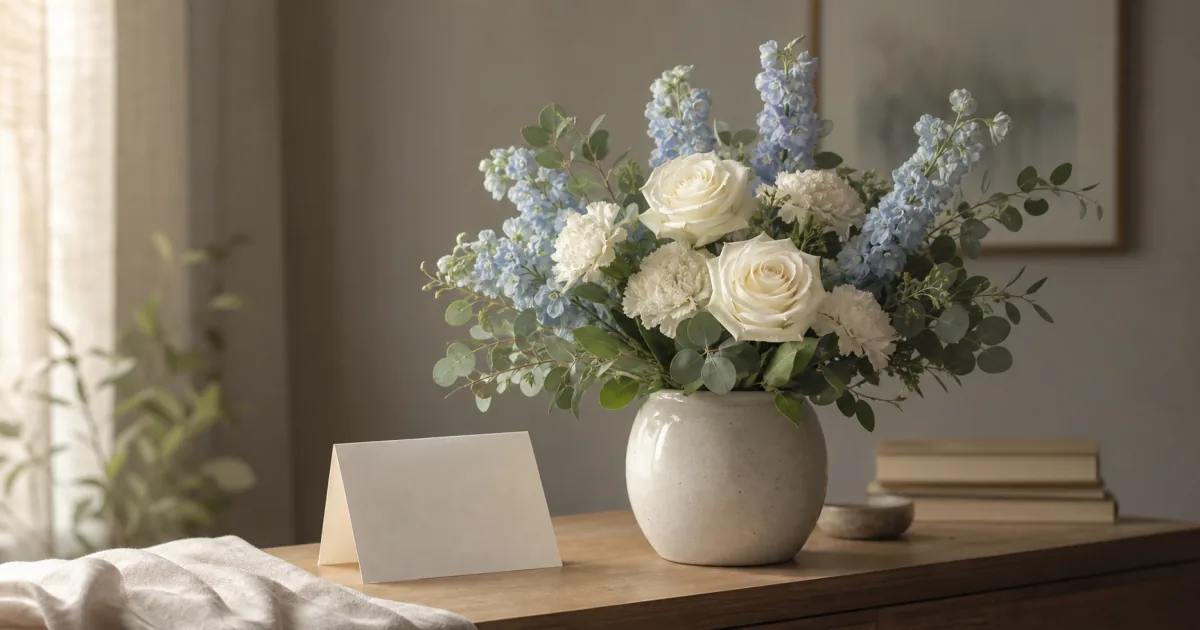
Quick answer: First read the obituary or service notice. Choose a design appropriate to the destination, include a short personal card, and confirm delivery details before ordering. If the family requests donations instead of flowers, honor that request.
The most useful decision order
- Check the family's wishes.
- Choose the correct destination.
- Match the arrangement to that setting.
- Write a simple, personal note.
- Confirm timing, recipient details, and household safety.
Begin with the family's wishes
An obituary may name a preferred charity, place of worship, community fund, or other memorial request. “In lieu of flowers” is a direct cue: if you plan to make one gesture, choose the requested contribution. You may still send a personal note, offer practical help, or check in later.
Do not assume every family or faith tradition uses flowers in the same way. When you are uncertain, ask the funeral home, a close family contact, or the relevant place of worship before ordering.
Choose the destination before the flowers
For a funeral home or memorial service
Standing sprays, wreaths, crosses, and other large tributes are designed for service display. These are often sent by relatives, groups, workplaces, associations, or close friends. Confirm that the venue accepts deliveries and provide the deceased's full name and service time.
For the family's home
A vase arrangement, compact basket, or easy-care plant is usually easier to receive at home. Keep the design manageable: the household may receive several deliveries and may have limited space or energy for arranging loose stems.
For a workplace
Before sending anything, check the organization's policy and whether the bereaved person is currently at work. A restrained desk-sized arrangement or a card from the team is generally easier to handle than a large display.
When should sympathy flowers arrive?
For a service, arrange delivery early enough for the florist and venue to coordinate setup. For the home, there is no requirement that flowers arrive immediately. A thoughtful delivery in the following days or weeks can be meaningful after the first rush of support has passed.
Do not promise a precise arrival time unless the florist confirms it. Hospitals, secure buildings, rural addresses, cemeteries, and houses of worship may have special delivery procedures.
Choosing flowers and colors
White and green arrangements are traditional in many settings, but they are not the only appropriate option. Roses, carnations, chrysanthemums, orchids, seasonal flowers, or a favorite bloom can create a more personal tribute. Let the recipient's preferences, the deceased's personality, and the destination guide the palette.
Avoid assigning universal meanings to a flower without context. Symbolism changes across cultures, regions, and families. If a specific color or species has cultural significance, verify it rather than relying on a generic flower-language chart.
What to write on the card
Use the deceased's name when appropriate, identify yourself clearly, and keep the message sincere. You do not need to explain the loss or find a perfect phrase.
- “I am so sorry for your loss. I am thinking of you and your family.”
- “Remembering Jordan with warmth and gratitude. With deepest sympathy.”
- “We are holding you close in our thoughts. From everyone on the design team.”
Avoid minimizing grief, offering an explanation for the death, or placing pressure on the recipient to reply. If you knew the deceased, one brief and specific memory can be more comforting than a formal statement.
Practical checks before ordering
- Confirm the recipient's name, address, and service details.
- Ask whether the venue accepts floral deliveries.
- Check the household for cats, dogs, allergies, fragrance sensitivity, or limited space.
- Read the substitution policy if exact flowers or colors matter.
- Sign the card so the family knows who sent the arrangement.
Cat-safety reminder
Do not send true lilies or daylilies to a home with cats. Pollen and vase water can also be dangerous. Ask for a lily-free arrangement and request that substitutions remain lily-free.
Sympathy Flower Products to Compare
These current products illustrate different condolence styles for delivery to a home or office. They are not a universal ranking. The links go directly to the merchants and do not currently contain affiliate tracking. Confirm the destination, household pets, flower substitutions, delivery date, and final checkout total before ordering.
Clear Skies Bouquet
FTD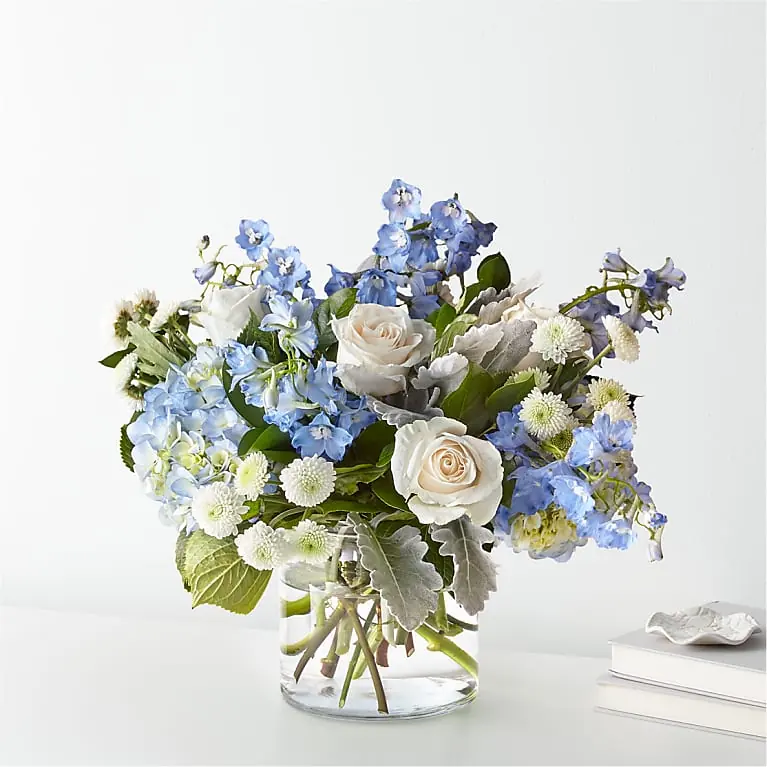
A blue-and-white florist arrangement featuring hydrangea, delphinium, and roses. Its vase-sized format is more practical for a family home than a standing service piece, while the color palette offers an alternative to an all-white arrangement.
Pros
- Appropriate scale for home or office delivery
- Multiple size choices and possible same-day service
Cons
- Not a pet-safe selection; verify the household and substitutions
- Delivered design may differ from the product image
Beautiful in Blue
Teleflora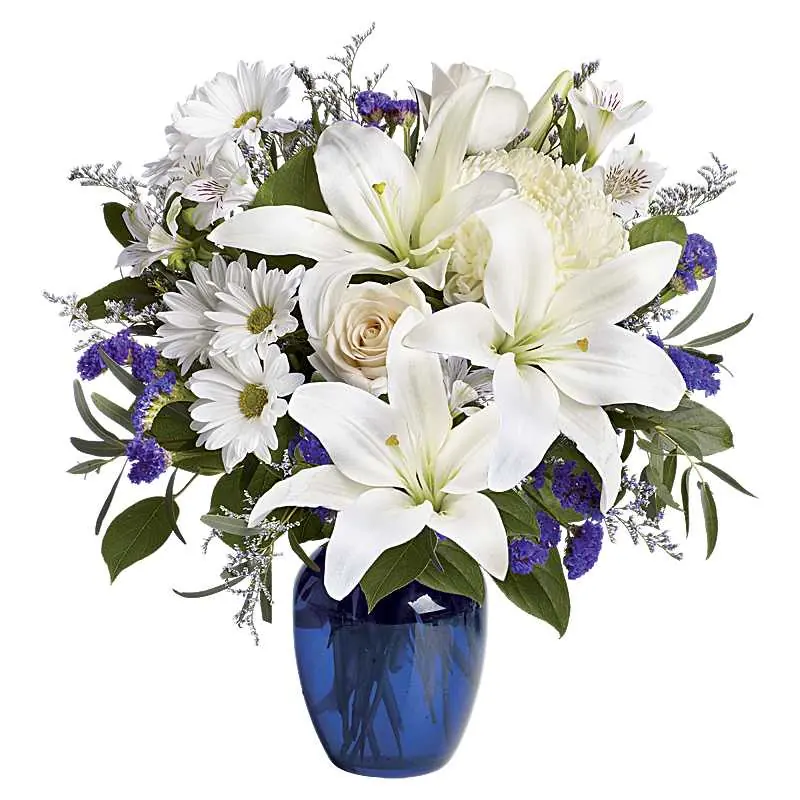
A traditional white floral arrangement in a cobalt-blue glass vase, with roses, lilies, alstroemeria, chrysanthemums, and greenery. It is designed for direct hand delivery and arrives ready to display.
Pros
- Hand-arranged by a local florist
- Vase is included for easier home delivery
Cons
- Contains lilies and should not go to a home with cats
- Exact blooms or container can be substituted
Comforting Thoughts™ Bouquet
1-800-Flowers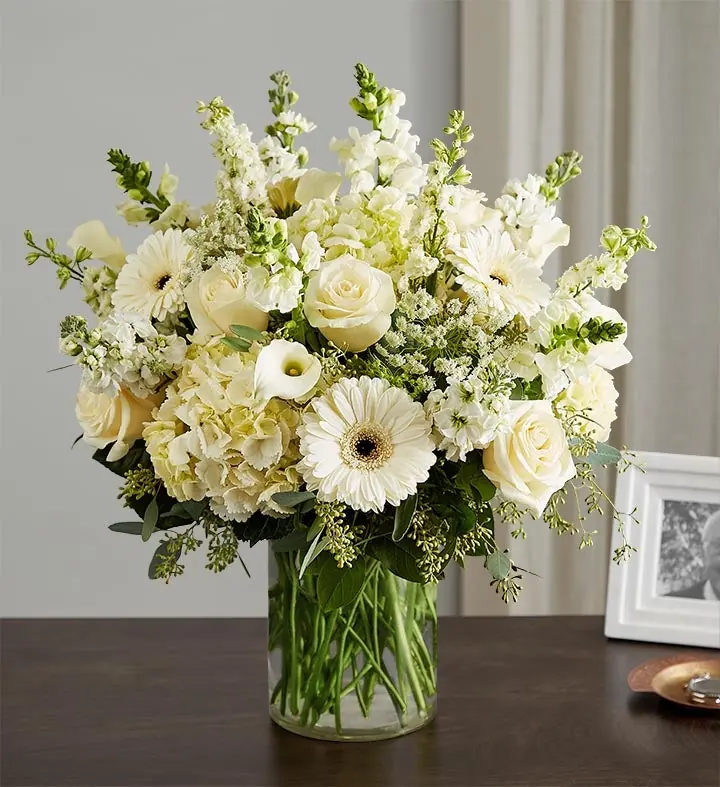
An all-white sympathy arrangement with hydrangeas, mini calla lilies, roses, daisies, snapdragons, stock, and greenery. The neutral palette fits a traditional condolence message and the arrangement is offered in multiple sizes.
Pros
- Restrained all-white presentation
- Hand-delivered by a local florist where available
Cons
- Calla lilies and other stems require a pet-safety check
- Final price varies with size and delivery fees
Sources and related guides
- Emily Post Institute: Sympathy Flowers
- Emily Post Institute: Donations in Lieu of Flowers
- U.S. FDA: Lilies and Cat Safety
See also funeral sprays and wreaths, sympathy flowers for a friend, and workplace sympathy etiquette.